- Frontpage
- · APQP4Wind Resources
- · Knowledge Hub
- · Warranty Thinking Costs Wind Leaders Millions
Why Warranty Thinking is Costing Wind Energy Leaders Millions
Most wind energy risk models are built on the wrong assumption - they optimize for warranty exposure instead of lifecycle failure. With more than 1,000 GW of global wind capacity, this gap is now a financial reality. Warranty exposure is no longer just an operational issue; it is a system-level risk that directly affects valuation, investor confidence, and long-term project economics.
Each failure, whether in a turbine, cable, or transformer, should not be viewed as an isolated event, but as the financial consequence of earlier decisions made during design, production, and farm-level planning.
From turbine risk to energy system risk
Offshore wind farms are complex energy systems. Turbines operate in fleets of 50-100 units, connected via one or two export cables stretching 25-200 km to shore, and supported by offshore transformer stations. Failures at any level can propagate rapidly, affecting energy production far beyond individual turbines. This challenges the industry’s persistent focus on turbine-level reliability as the primary risk driver.
Studies from DNV and the Fraunhofer Institute for Wind Energy Systems show that system-level failures, particularly in electrical infrastructure, can have disproportionately large impacts compared to individual turbine faults.
As turbine sizes increase and supply chains grow more complex, reliability and quality management have shifted from operational concerns to strategic imperatives. Even minor defects can cascade across projects, leading to delayed energy delivery, strained supplier relationships, and unplanned capital outflows. System-level considerations such as cabling, transformer stations, and interdependencies across the wind farm must be incorporated alongside turbine reliability to fully understand risk.
The design-lifecycle misalignment
Many wind projects are still optimized during manufacturing and throughout the warranty period, rather than for the 30-year operating reality they are expected to meet. This creates a structural misalignment between how project costs are planned and how risk and maintenance costs actually materialize over the product lifetime.
Where Cost of Poor Quality (CoPQ) becomes lifecycle risk
Cost of Poor Quality (CoPQ) is realized in both manufacturing and operations, but it is structurally defined long before deployment. However, the majority of financial exposure does not occur during manufacturing or the warranty period; it occurs after the warranty period expires.
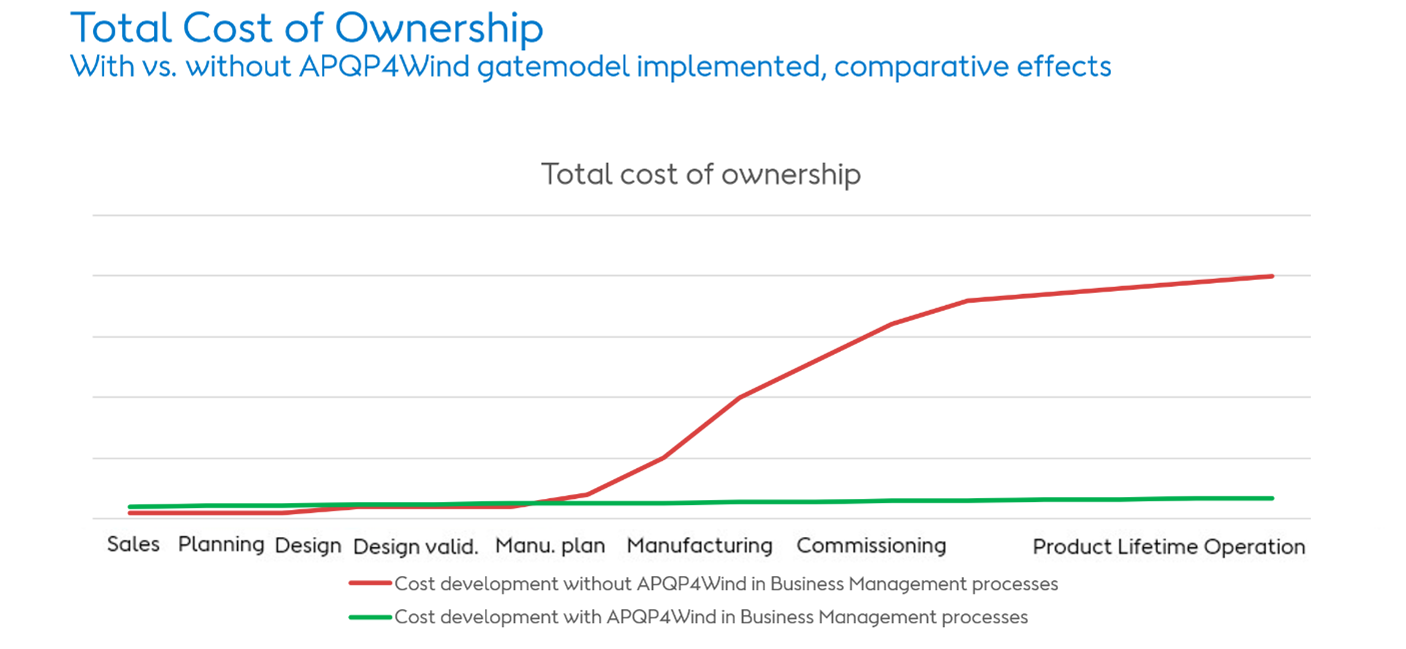 Organizations that fail to control risk early do not eliminate cost; they defer and amplify it across the lifecycle, resulting in a significantly higher total cost of ownership.
Research from the National Renewable Energy Laboratory (NREL) shows that operations and maintenance costs represent a significant share of lifecycle costs and are strongly influenced by reliability and system design.
- Warranty period (2-5 years): defects and failures are primarily the supplier’s responsibility
- Post-warranty lifecycle (up to 30 years): costs shift to the operator, including maintenance, component replacements, and system-level failures
The financial reality of energy system failure
This lifecycle misalignment becomes visible in the financial impact of failures. Focusing only on turbine warranties significantly underestimates total exposure.
At turbine level, equipment failures account for 35-45% of downtime, with major component replacements such as gearboxes or blades representing 25–30% of total maintenance costs.
At the system level, the risk profile changes entirely. Failures in export cables or transformer stations can shut down half, or in some cases, the entire wind farm, leading to multi-million-dollar losses and potential regulatory penalties. According to ORE Catapult, export cable failures are among the most costly offshore incidents due to repair complexity and extended downtime.
This is the critical shift: system-level failures do not scale linearly. They cascade across assets.
Wind projects are increasingly capital-intensive and form a core part of national energy infrastructure. According to WindEurope, Europe recently installed 19.8 GW of new wind capacity, representing approximately €24.8 billion in investment. Wind energy now generates around 20% of all electricity consumed in Europe (19% in the EU). At this scale, a single system failure can ripple across entire portfolios, affecting project economics, cash flow predictability, and company reputation. Risk must therefore be evaluated at the system level, not the turbine level.
What warranty exposure actually reveals
Warranty claims and unplanned maintenance costs are not random events but delayed signals of upstream failure. They point to inaccurate requirements, gaps in design risk assessment, weaknesses in supplier qualification, inconsistencies in manufacturing processes, and limited transparency across increasingly complex global supply chains.
In offshore wind, these weaknesses are amplified by fleet- and system-level interactions. A single design flaw or process deviation can affect kilometers of export cables, dozens of turbines, and critical wind farm infrastructure, escalating costs beyond the warranty period and across the wind farm’s full 30-year lifecycle. Warranty exposure and unplanned maintenance costs should therefore not be treated as cost categories, but as diagnostic indicators of systemic quality maturity.
Structured quality frameworks similar to those used in automotive and aerospace are designed to address this challenge. A framework such as APQP4Wind shifts the focus from reacting to failures in manufacturing or operations to controlling risk during requirements definition, design and industrialization – when it is still manageable.
From reactive quality to proactive control
By enforcing early risk identification, robust design validation, and controlled production processes, organizations shift costs away from unpredictable, high-impact failures in manufacturing and operations toward planned investments during development and industrialization. These costs are often referred to as Total Cost of Quality. The result is a more stable and predictable cost curve, which reduces unplanned warranty provisions and maintenance costs, and ultimately improves financial forecasting accuracy.
Leading developers and OEMs now treat warranty exposure and infrastructure failures as indicators of systemic risk rather than isolated incidents. Organizations with mature quality frameworks move from reacting to failures to controlling when and where risk materializes. In other words, they:
- Identify potential failure modes during component development and system layout planning
- Validate processes across the value chain
- Detect risk patterns in critical infrastructure before deployment
Proactive quality does not only reduce cost – it relocates it from unpredictable failure to controlled investment. Standardized quality systems strengthen supply chain resilience, enable faster root cause analysis and corrective actions, and prevent systemic issues from scaling across projects and fleets.
For wind energy leaders, this is the real shift: proactive quality management transforms warranty exposure from a reactive liability into a strategic lever for controlling risk, protecting cash flow, and improving long-term project economics.
Total Cost of Quality as a strategic and systemic indicator
Warranty exposure and unplanned maintenance costs now reflect both financial risk and operational maturity across the entire wind farm system.
Embedding structured quality governance across the value chain enables:
- Earlier visibility into systemic risk
- Stronger supplier accountability
- More predictable project outcomes across turbines and farm infrastructure
In a scaling wind industry, competitive advantage will favor those who achieve the lowest lifecycle cost of failure, not just the highest installed capacity.
From reactive cost to strategic control
Organizations that treat warranty and unplanned maintenance as after-sales issues (or opportunities) remain exposed to systemic risk. Those that shift accountability upstream into requirements management, design, production, and system-level planning gain control over when, where, and at what scale costs occur, transforming warranty and maintenance exposure from a reactive liability into a proactive strategic lever.
Competitive advantage will not be defined by installed capacity, but by the ability to control lifecycle risk. The question is no longer whether failures will occur, but where in the system they originate, who ultimately carries the cost, and how transparently systems are integrated into preventive maintenance programs to avoid failures occurring in operational systems.
This is where the wind industry is beginning to divide. Between those who remain driven by warranty outcomes, and those who take control earlier in the lifecycle through structured quality frameworks like APQP4Wind.